

RFID Adoption in Retail: Where It Stands and Where It's Going
Why Retailers Are Finally Making RFID Work ??and What Changed
RFID has been promising to transform retail since the early 2000s. Walmart's 2003 mandate to its top 100 suppliers was supposed to be the catalyst. It wasn't ??not yet. The technology was too expensive, the tags unreliable at scale, and the ROI case difficult to make stick. Over the next two decades, RFID stayed in the conversation but rarely moved beyond pilot programs for most retailers.
2025 is different. The global RFID retail market was valued at approximately USD 14.5 billion in 2025 and is projected to reach USD 35.56 billion by 2035, with a CAGR of 9.39%, according to market research data. More practically, a recent Accenture report found that 93% of North American retailers were using RFID technology in some capacity as of late 2024. What changed is a combination of economics, operational pressure, and technology maturation that has moved RFID from experimental to essential for a growing share of retail operations.
Where Does RFID Retail Adoption Stand in 2025?
The headline numbers are striking. RFID passive tag costs have dropped approximately 80% over the past decade, with standard tags now averaging around USD 0.04 per unit. Hardware ??readers, antennas, printers, and encoders ??has become 40??0% more affordable and significantly more capable. The economics that made RFID impractical for most retail categories in 2005 now support widespread item-level deployment.
Adoption is concentrated in specific segments but accelerating broadly. According to ABI Research, clothing and footwear accounts for 74% of total RFID software and services spending in 2025, reflecting the apparel sector's early-adopter position. The retail apparel sector alone is expected to require over 31 billion RFID tags in 2025. But the share of apparel in total retail RFID is projected to decline to 55% by 2030 as grocery, general merchandise, and electronics deployments scale up.
The performance numbers from early adopters are compelling. Retailers implementing RFID have achieved inventory accuracy rates of approximately 95??9%, compared to 65??0% typical of operations relying on barcode scanning and manual processes, according to industry data. Macy's reported an 18% reduction in stock discrepancies and a 9% sales lift in RFID-enabled categories. Walmart improved accuracy from approximately 65% to over 95% in RFID-deployed categories, reducing out-of-stocks by 10??5%.
Which Retail Sectors Lead in RFID Adoption?
Apparel and fashion: the earliest and deepest adopter
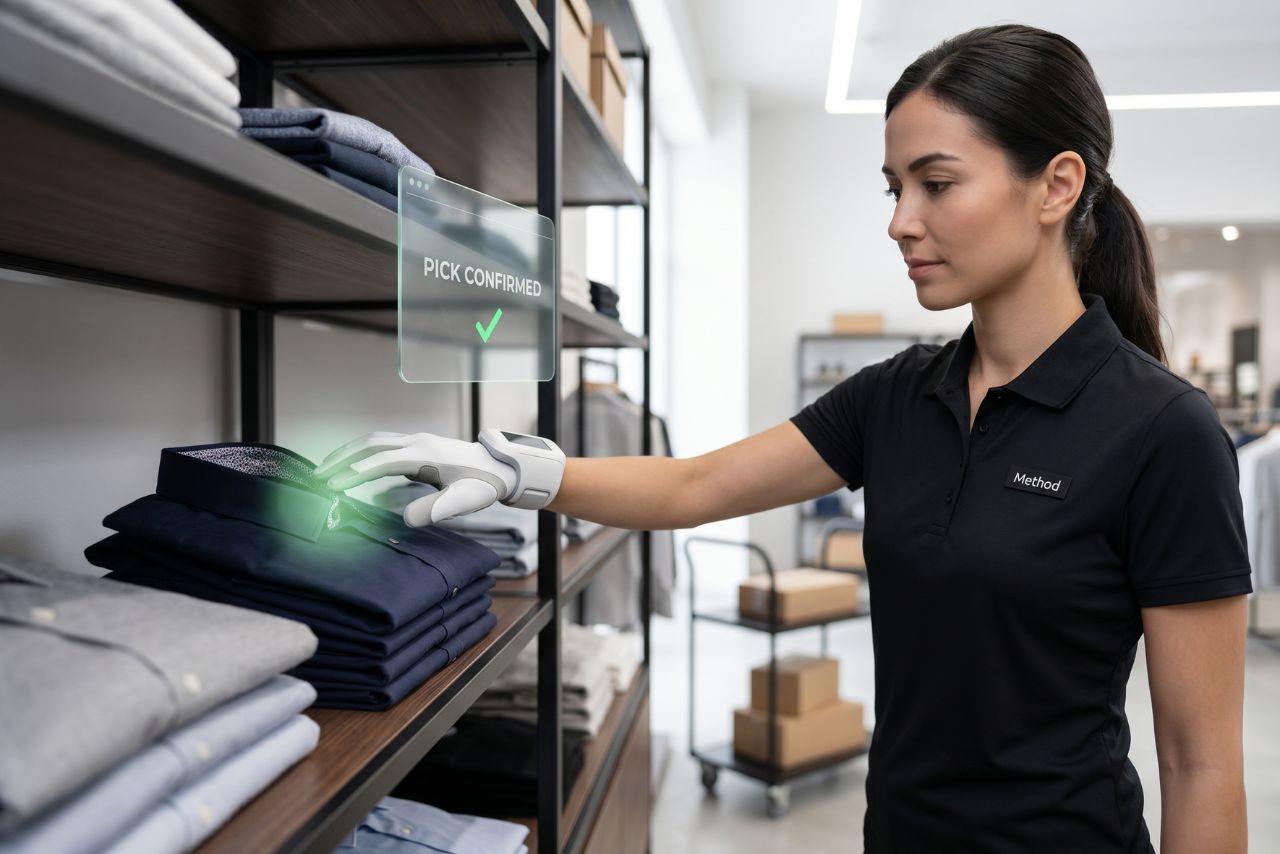
Apparel has been the proving ground for retail RFID. The economics make sense: high SKU counts across size and color variants create inventory accuracy challenges that manual processes can't adequately solve, the item value justifies the tag cost, and the supply chain infrastructure for tagging at source has been built out over years. Zara (Inditex) has deployed RFID across its entire global product range since 2014. H&M, Lululemon, Nike, Adidas, and Decathlon have all implemented large-scale programs. The result: Lululemon has reported reaching 98% inventory accuracy with a payback period of under one year.
Grocery and food: slower but accelerating
Grocery has been slower to adopt RFID, for reasons rooted in the economics and physics of food products. Liquid products interfere with radio frequency signals; the item value is often low relative to tag cost; and the fresh category moves too quickly for traditional tag-and-read workflows. But the pressure points are shifting. Walmart expanded its RFID mandate in February 2025 to include electronics and home goods, building on earlier apparel mandates. Kroger began rolling out RFID-embedded labels in its bakery department in late 2024, with plans to expand to other perishable categories. Temperature monitoring and expiration date management in cold chain are emerging as high-value use cases that justify the investment.
Electronics and general merchandise: fastest growth
Electronics and technology products are projected to see the fastest RFID adoption growth through 2034, according to market research from Emergen Research. High product value justifies tag costs, warranty tracking and authentication requirements create natural use cases, and the supply chain complexity of electronics benefits from item-level visibility. In general merchandise, Walmart's expanded mandates are creating a pull-through effect: as Walmart requires tagging, suppliers implement the capability and often extend it across their broader retail customer base.
What's Actually Driving Full-Scale Deployment Now?
Tag cost economics
At USD 0.04 per passive RFID tag, the economics work for categories that previously couldn't justify the investment. This is the most fundamental enabler of the current adoption wave.
Retailer mandates creating supply chain pull
When Walmart requires RFID tagging from its suppliers, those suppliers must build the capability. That capability then becomes available to other retail customers at incremental cost. Major retailer mandates function as market-wide adoption accelerators.
GS1 Sunrise 2027 and the 2D transition
GS1's Sunrise 2027 initiative calls for retail point-of-sale systems to be capable of reading 2D codes (QR codes and Data Matrix) alongside traditional UPC barcodes by 2027. This isn't RFID, but it's part of the same broader shift toward richer, more capable identification technologies in retail ??and it's accelerating investment in scanning infrastructure that can read multiple technologies simultaneously.
AI systems need clean inventory data
Retailers are investing heavily in AI-driven forecasting, dynamic pricing, allocation optimization, and personalized recommendations. All of these systems depend on accurate inventory data. RFID provides the item-level visibility that makes AI applications viable ??it becomes the data infrastructure that downstream AI systems run on.
What Can RFID Do That Barcode Can't?
The technical differences that drive the retail use case:
- No line of sight required: RFID reads through packaging, around corners, and through stacked items. A handheld RFID reader can inventory a full shelf fixture without touching a single item.
- Bulk reading: a single reader pass can capture hundreds of items simultaneously. A full cycle count that takes hours with barcode scanners can be completed in minutes with RFID.
- Real-time location: fixed RFID readers at key points (store entrances, stockroom doors, fitting rooms) provide continuous, passive visibility into item movement without any manual scanning.
- Smart shelf integration: RFID-enabled shelf systems can alert staff when inventory drops below replenishment threshold, automatically, without anyone needing to walk the floor and check.
- Loss prevention integration: RFID combined with electronic article surveillance (EAS) systems enables hybrid anti-theft solutions that both deter theft and generate inventory data.
Where Does Barcode Fit Once You Have RFID?
RFID and barcode are not mutually exclusive, and in most real-world retail operations they coexist. Barcode remains the standard for POS transactions in most contexts, because it's faster per-item at a single-item checkout lane and compatible with existing infrastructure. RFID excels at bulk operations ??inventory counting, receiving, stock location ??where its no-line-of-sight and bulk-read advantages compound across thousands of daily transactions.
The practical picture in a mature RFID retail deployment: items are RFID-tagged at the source. They're tracked through the supply chain and receiving process via RFID. In-store inventory management uses RFID handheld readers and fixed reader infrastructure. At POS, items are scanned via barcode (or a combined RFID/barcode reader) for the individual transaction. Returns are processed via RFID scan to confirm item identity and update inventory in real time.
For retailers evaluating RFID, the question isn't whether to replace barcode. It's which processes benefit most from RFID's specific capabilities, and what the ROI of implementing those processes first looks like.
What Should a Retailer Consider Before Adopting RFID?
- Tag economics by category: calculate the tag cost as a percentage of item value for each product category you're considering. The economics work differently at USD 50 versus USD 5 item values.
- Where in the supply chain to tag: source tagging (supplier applies tags during production) is lower cost than retailer-applied tagging. Does your supply chain support source tagging for your key categories?
- Reader infrastructure: fixed readers at key locations (dock doors, store entrances, stockroom doors) provide the most value but require installation and networking. Handheld RFID readers are lower infrastructure cost and provide flexible cycle count capability.
- Integration with existing systems: RFID generates large volumes of data. Where does it go? Your ERP, WMS, or store management system needs to be capable of ingesting and acting on RFID event data.
- Start with your highest-impact use case: inventory accuracy in your highest-shrink or highest-stockout categories is usually the fastest ROI. Build from there.
The Bottom Line: RFID in Retail Is No Longer Optional for Many
For apparel retailers, RFID has moved from competitive advantage to table stakes. For grocery, it's moving from experiment to operational necessity in specific categories. For general merchandise, retailer mandates are creating a compliance-driven adoption wave regardless of each supplier's own ROI analysis.
For retailers who haven't yet evaluated RFID seriously, 2025 is the right time to start. The technology has matured, the economics have improved dramatically, and the operational results from early adopters are documented and credible. The relevant question is no longer whether RFID will be part of retail infrastructure ??it already is for a growing share of the market ??but which implementation approach and timeline makes sense for your specific operation.
Explore our Product Range to find RFID and barcode scanning hardware suited to retail environments and supply chain applications.
Ready to Upgrade Your Retail Hardware? While RFID drives macro-level inventory tracking, high-speed 2D barcode scanners remain the essential backbone for POS and self-service kiosks. ALVICS supplies reliable, white-label scanning hardware to SIs and distributors globally.